

新闻资讯
Latest News
2026/09/16

2026/09/04
Clinical Blood Pressure Monitor for Doctors: Accuracy Standards, Validation Protocols, and Selection Guide
Release time:2026-09-16
Preface
High blood pressure affects nearly half of all adults in the United States, yet only one in four has their condition under control. Accurate blood pressure measurement is one of the most powerful tools clinicians have for preventing and managing cardiovascular disease, and the device used to obtain that measurement must be reliable, validated, and appropriate for the clinical setting.
A clinical blood pressure monitor for doctors is a professional-grade device designed for use in medical offices, hospitals, and clinics, featuring validated accuracy according to internationally recognized protocols such as AAMI, ESH, and ISO 81060-2. The British and Irish Hypertension Society maintains a gold-standard list of validated blood pressure monitors recommended by the NHS, and only devices that pass rigorous independent testing earn inclusion.
Meanwhile, the global blood pressure monitoring devices market was valued at USD 4.2 billion in 2025 and is projected to reach USD 8.6 billion by 2033, growing at a CAGR of 9.3 percent. This guide is written for physicians, clinical procurement teams, hospital administrators, medical device distributors, and healthcare professionals who need to understand accuracy standards, validation protocols, regulatory requirements, and practical selection criteria for clinical blood pressure monitors used in professional healthcare settings.
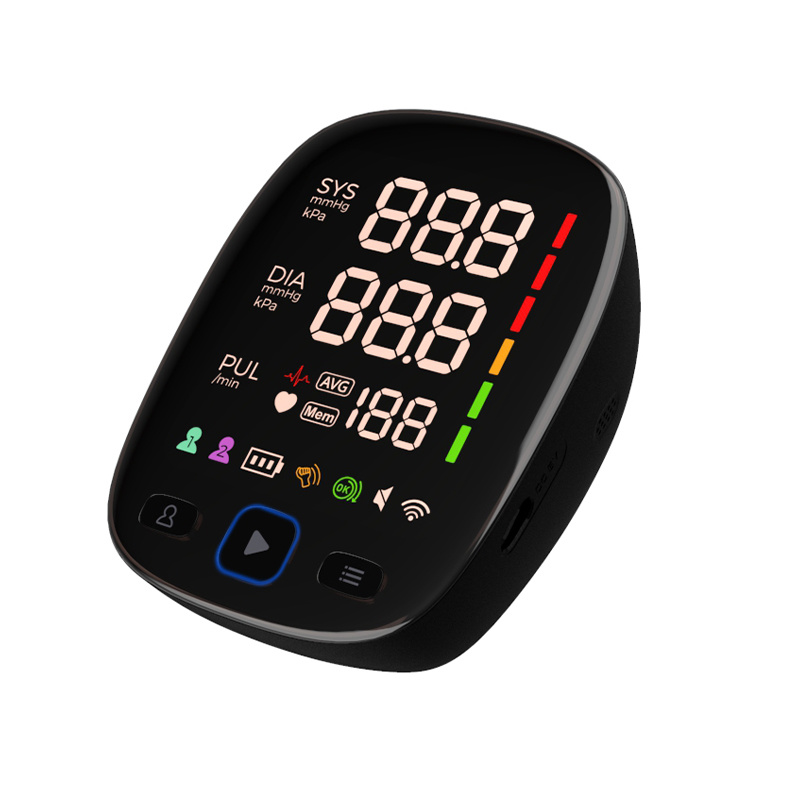
Table of Contents
1. What Is a Clinical Blood Pressure Monitor for Doctors?
2. How Oscillometric Blood Pressure Measurement Works
3. Accuracy Standards: AAMI, ESH, and ISO 81060-2
4. Clinical Validation Protocols: What Doctors Need to Know
5. The Blood Pressure Monitoring Devices Market: Size and Growth
6. Finicare Clinical Blood Pressure Monitor Technology
7. Key Features to Evaluate in a Professional Blood Pressure Monitor
8. Blood Pressure Monitor Recalibration and Device Lifespan
9. Connected Devices: Wi-Fi, Bluetooth, and EHR Integration
10. Selecting the Right Clinical Blood Pressure Monitor: A Checklist
Summary
References
1. What Is a Clinical Blood Pressure Monitor for Doctors?
A clinical blood pressure monitor for doctors is an automated oscillometric device designed to measure systolic blood pressure, diastolic blood pressure, and pulse rate with accuracy sufficient for clinical decision-making. Unlike consumer-grade home monitors, professional clinical devices must meet stricter validation requirements and are typically used in environments where measurement reliability directly impacts patient diagnosis and treatment.
The American Heart Association recommends upper-arm cuff-based monitors as the standard for clinical blood pressure measurement. Wrist and finger monitors are not recommended for routine clinical use due to their susceptibility to positioning errors and lower accuracy. The American Medical Association maintains the SMBP (Self-Measured Blood Pressure) Device Accuracy Listing, which identifies devices that have passed independent clinical testing according to established protocols.
A professional clinical blood pressure monitor typically includes an electronic unit with a digital display, an inflatable arm cuff with a pneumatic tube, automatic inflation and deflation mechanisms, memory storage for multiple readings, and irregular heartbeat detection. Advanced models may feature Wi-Fi or Bluetooth connectivity, dual-user profiles, color-coded blood pressure classification indicators, and integration with electronic health record systems.
The distinction between a clinical device and a home device is important. A 2024 quality improvement analysis published in the American Journal of Hypertension found that one in five home blood pressure devices did not agree with office devices based on the AMA SMBP accuracy criteria. This underscores the value of using validated clinical-grade monitors in professional settings where diagnostic accuracy is paramount.
2. How Oscillometric Blood Pressure Measurement Works
Modern clinical blood pressure monitors for doctors use the oscillometric method, which detects pressure oscillations in the cuff caused by arterial pulsation during inflation and deflation. The device inflates the cuff to a pressure above the expected systolic level, then slowly deflates it. As the cuff pressure decreases, the arterial wall begins to pulsate, generating small pressure oscillations that the device sensor detects.
The amplitude of these oscillations increases as cuff pressure approaches the mean arterial pressure and then decreases as pressure continues to fall. The device microprocessor analyzes the oscillation amplitude envelope to calculate systolic, diastolic, and mean arterial pressure values using proprietary algorithms validated during clinical testing.
Proper cuff sizing is critical for accurate measurement. A cuff that is too small will overestimate blood pressure, while a cuff that is too large will underestimate it. Most clinical monitors include a range-fitting cuff that accommodates arm circumferences from 22 to 42 centimeters, with some models offering extra-large cuffs for patients with arm circumferences exceeding 42 centimeters. The National Council on Aging recommends selecting monitors with cuff sizes that match the patient population served.
The measurement position also affects accuracy. The patient should be seated with feet flat on the floor, back supported, and the arm resting at heart level. The cuff should be positioned on the bare upper arm with the artery marker aligned over the brachial artery. Clinical guidelines recommend taking at least two readings separated by one to two minutes and recording the average.

3. Accuracy Standards: AAMI, ESH, and ISO 81060-2
Three major international standards govern the accuracy of clinical blood pressure monitors used by doctors.
AAMI (Association for the Advancement of Medical Instrumentation). The AAMI standard specifies that the mean difference between the test device and the reference standard must not exceed 5 mmHg for systolic or diastolic pressure, with a standard deviation of no more than 8 mmHg. This standard has been the foundation of blood pressure device validation for decades and is referenced by the FDA in its regulatory framework.
ESH (European Society of Hypertension). The ESH protocol uses a phased approach with three stages of testing. Phase 1 requires at least 33 subjects and evaluates basic accuracy. Phase 2 expands the sample to 84 subjects and applies stricter statistical criteria. Phase 3 assesses device performance in special populations such as children, pregnant women, and elderly patients. A device that passes all three phases receives full ESH validation.
ISO 81060-2:2018. This internationally harmonized standard combines elements of both the AAMI and ESH protocols into a unified framework. It requires a minimum of 85 subjects for the general population validation study and specifies both static and dynamic accuracy requirements. The ISO standard is increasingly adopted as the global benchmark and is referenced by regulatory bodies including the FDA, CE MDR authorities, and the TGA.
In 2026, a clinical validation study published in Blood Pressure journal confirmed that the Omron HEM-790XT1 electronic blood pressure monitor met all accuracy requirements of the AAMI/ESH/ISO universal standard, demonstrating that modern oscillometric devices can achieve clinical-grade accuracy when properly validated.
4. Clinical Validation Protocols: What Doctors Need to Know
Clinical validation is the process by which an independent research team tests a blood pressure monitor against a mercury sphygmomanometer or an intra-arterial reference standard. The results determine whether the device is suitable for clinical use.
The British and Irish Hypertension Society maintains the gold-standard validated device list, which is recommended by NICE and NHS England. According to BIHS, the approved list is maintained through a review of published validations where investigators have followed a recognized BIHS or similar European or International validation protocol. Devices that appear on this list have demonstrated accuracy suitable for both clinical and home settings.
For procurement teams and physicians, the BIHS list provides a practical tool for device selection. When purchasing monitors for a clinic, hospital department, or pharmacy, using only devices on the BIHS approved list ensures that the equipment meets internationally recognized accuracy standards. Devices with unverified claims or those that have not been independently tested should be avoided.
The ACCU-RATE study, a cross-sectional observational study published in the British Journal of General Practice, revealed that the accuracy of blood pressure monitors owned by patients with hypertension can degrade over time. This finding has implications for clinical practice: doctors should not only recommend validated devices to patients but also advise them on device replacement timelines to maintain measurement accuracy.
5. The Blood Pressure Monitoring Devices Market: Size and Growth
The global blood pressure monitoring devices market was valued at USD 4.2 billion in 2025 and is projected to grow from USD 4.6 billion in 2026 to USD 8.6 billion by 2033, representing a compound annual growth rate of 9.3 percent. This robust growth reflects increasing awareness of hypertension as a leading cause of cardiovascular mortality and the expanding adoption of home and clinical monitoring worldwide.
The digital blood pressure monitors segment specifically is estimated at USD 1.92 billion in 2026 and is expected to reach USD 3.76 billion by 2033. Automated upper-arm monitors dominate the market, accounting for the majority of clinical and home device sales. Connected devices with Bluetooth or Wi-Fi capabilities represent the fastest-growing sub-segment, driven by telehealth adoption and remote patient monitoring programs.
Key market drivers include the rising global prevalence of hypertension, which affects an estimated 1.28 billion adults aged 30 to 79 worldwide according to the World Health Organization. The shift toward value-based care models that reward preventive monitoring over reactive treatment further accelerates demand. Additionally, government initiatives such as the CMS remote patient monitoring reimbursement codes in the United States create financial incentives for healthcare providers to deploy connected blood pressure monitoring programs.
Regional dynamics show that North America holds the largest market share, supported by advanced healthcare infrastructure, high awareness of hypertension management, and favorable reimbursement policies. Asia-Pacific is the fastest-growing region, driven by expanding healthcare access, rising chronic disease prevalence, and increasing government investment in primary care infrastructure.

6. Finicare Clinical Blood Pressure Monitor Technology
Finicare was established in 2017 and is a high-tech enterprise integrating research and development, manufacturing, and sales. Headquartered in Shenzhen, China, the company specializes in electronic blood pressure monitors, infrared thermometers, digital thermometers, pulse oximeters, and other home and clinical medical devices. Finicare products are exported to more than eighty countries across Europe, North America, the Middle East, and Southeast Asia.
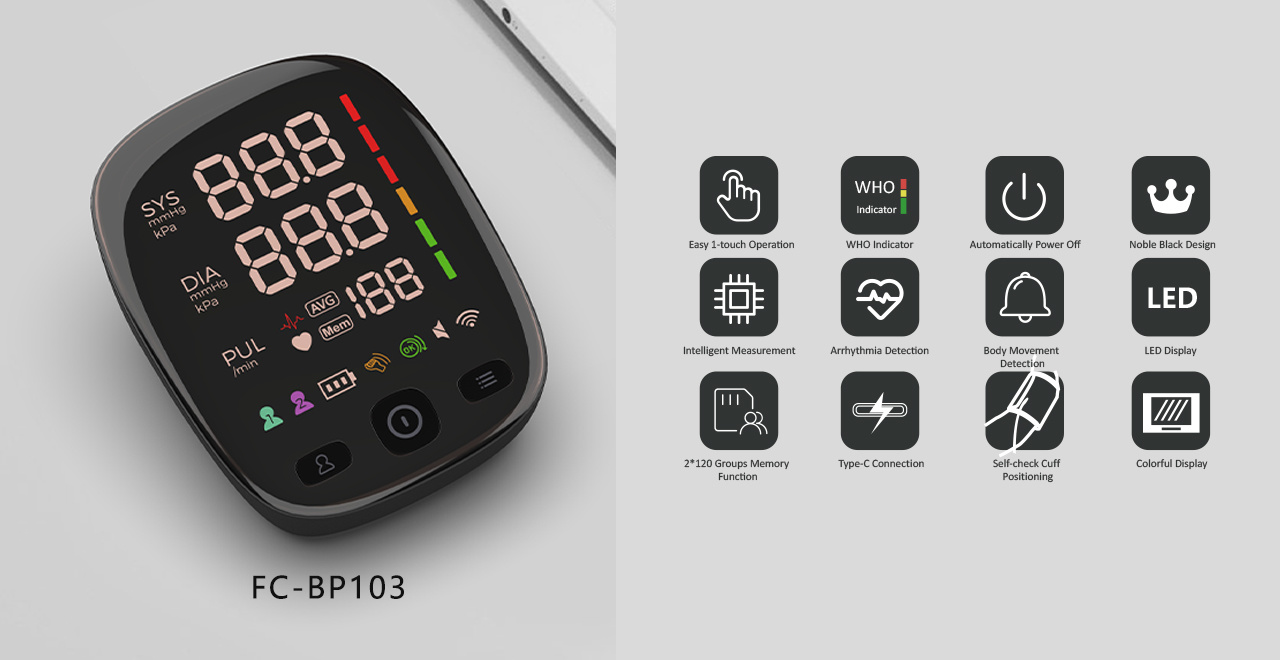
The Finicare BP103 is a professional-grade clinical blood pressure monitor designed for both clinical and home use. It features a sleek two-tone design with a glossy black top panel and a matte white base, creating a modern medical-grade aesthetic. The large high-contrast LED display shows systolic, diastolic, and pulse readings simultaneously in clearly visible white digits against the black background. A distinctive color-coded health risk indicator bar runs vertically along the right side of the display, transitioning from green through orange to red to provide instant visual classification of the patient's blood pressure status. The display also shows connectivity status icons including Wi-Fi and Bluetooth indicators, dual-user profile selection, battery level, and irregular heartbeat detection. Physical controls include a large circular start button, a menu button, and a user profile selection button, all arranged ergonomically on the right side of the display panel.
Every Finicare blood pressure monitor is manufactured under ISO 13485 quality management and carries a full suite of international certifications including FDA 510(k), CE (MDR), TGA, MDL, UKRP, NMPA, FSC, FCC, and RoHS. Factory systems hold ISO 13485, MDSAP (Medical Device Single Audit Program), and BSCI (Business Social Compliance Initiative) certifications. Each production unit undergoes incoming material inspection, in-process quality control, 100 percent final functional testing, and outbound audit before shipment.
7. Key Features to Evaluate in a Professional Blood Pressure Monitor
When selecting a clinical blood pressure monitor for doctors, several features directly impact measurement quality, clinical workflow, and patient experience.
Display clarity. A large, high-contrast display is essential in clinical environments where readings must be quickly visible to both clinicians and patients. Color-coded classification indicators that map readings to hypertension stage categories improve workflow efficiency by providing instant visual context.
Cuff size range. Clinical settings serve diverse patient populations with varying arm circumferences. A monitor with a wide cuff range, ideally 22 to 42 centimeters or greater, accommodates most adult patients without requiring cuff exchanges. For bariatric or pediatric patients, confirm availability of specialized cuffs.
Memory capacity. Professional monitors should store at least 60 to 100 readings per user to support longitudinal tracking. For multi-user clinical environments, dual or unlimited user profiles prevent data mixing between patients.
Measurement speed. Faster measurement times, ideally under 40 seconds, improve patient compliance and clinical throughput. The National Council on Aging tested several leading monitors and found average reading times ranging from 28 to 60 seconds.
Irregular heartbeat detection. This feature alerts clinicians to potential arrhythmias during blood pressure measurement, providing an additional diagnostic signal that may warrant further cardiac evaluation.
Power options. Professional monitors should support both battery and AC adapter power to ensure uninterrupted availability. USB-C charging is increasingly preferred for its universal compatibility and fast charging speed.

8. Blood Pressure Monitor Recalibration and Device Lifespan
The accuracy of automated blood pressure monitors can degrade over time due to sensor drift, cuff wear, and environmental factors. The British and Irish Hypertension Society provides clear guidance on device maintenance.
For monitors used in clinical environments including hospitals, GP surgeries, and pharmacies, manufacturers' instructions should be followed. The BIHS recommends that formal recalibration be regarded as a minimum requirement on an annual basis. This ensures that devices used for patient diagnosis and treatment decisions maintain their validated accuracy specifications throughout their service life.
For home monitors, the ACCU-RATE study provides real-world evidence that monitors should be replaced after a maximum of four years of use with a suitably validated replacement. They should be replaced sooner if there is evidence of damage, particularly to the cuff, or concern about accuracy. This guidance is relevant for doctors who recommend home monitoring to patients, as it establishes a clear replacement timeline.
Cuff integrity is a common failure point. The inflatable bladder inside the cuff can develop micro-leaks over time, leading to slow deflation rates and inaccurate readings. The Velcro closure can lose adhesion after repeated use, preventing proper cuff tension. Clinicians should inspect cuffs regularly and replace them according to the manufacturer's recommended schedule, typically every two to three years for devices in frequent clinical use.
Environmental factors also affect the accuracy of any clinical blood pressure monitor for doctors. Exposure to extreme temperatures, humidity, or direct sunlight can accelerate sensor degradation. Store monitors in a clean, dry environment at room temperature when not in use. Transport in protective cases to prevent physical damage to the display, buttons, and pneumatic connections.
9. Connected Devices: Wi-Fi, Bluetooth, and EHR Integration
The integration of blood pressure monitors with digital health platforms is transforming clinical workflows. Connected devices enable automatic data transmission from the monitor to clinical dashboards, electronic health record systems, and patient portals, eliminating manual data entry and reducing transcription errors.
Wi-Fi enabled monitors transmit readings directly to cloud-based platforms without requiring a paired smartphone or tablet. This is particularly valuable in clinical settings where staff manage multiple devices and patients throughout the day. The Finicare BP103 features both Wi-Fi and Bluetooth connectivity, supporting flexible deployment across different clinical workflows.
Bluetooth-enabled monitors pair with smartphones or tablets running companion apps that store, analyze, and share blood pressure data. These apps typically generate trend reports, flag out-of-range readings, and enable data export in PDF format for sharing with healthcare providers. For remote patient monitoring programs, Bluetooth devices paired with cellular hubs enable data transmission from patients' homes to clinical monitoring centers.
EHR integration is increasingly important for health systems adopting connected care models. Devices that support HL7 FHIR or proprietary API connections can populate patient records automatically, triggering clinical alerts when readings exceed predefined thresholds. This integration supports the growing remote patient monitoring infrastructure that over 60 percent of U.S. primary care practices have adopted as of 2026.
For procurement teams, confirm that connected devices comply with HIPAA data security requirements and that the manufacturer provides adequate cybersecurity documentation, including data encryption specifications and firmware update protocols.
10. Selecting the Right Clinical Blood Pressure Monitor: A Checklist
Use the following criteria when evaluating a clinical blood pressure monitor for doctors.
Validation status. Verify that the device appears on the BIHS validated device list or has passed an equivalent AAMI/ESH/ISO 81060-2 validation study published in a peer-reviewed journal. This is the single most important criterion for clinical accuracy assurance.
Regulatory clearance. Confirm FDA 510(k) clearance for the United States, CE MDR marking for Europe, or equivalent local regulatory approval. Check that the product code matches the intended use classification.
Cuff compatibility. Ensure the standard cuff accommodates the target patient population's arm circumference range. Verify availability of extra-large and pediatric cuffs if needed.
Display and interface. Evaluate display size, contrast, readability from different angles, and the presence of classification indicators. Test button responsiveness and menu navigation logic.
Memory and connectivity. Confirm adequate memory capacity for the intended use case. For connected care programs, verify Wi-Fi or Bluetooth capability and compatibility with existing EHR or remote monitoring platforms.
Durability and warranty. Clinical devices must withstand daily use in demanding environments. Check build quality, drop resistance, and warranty terms. A professional clinical blood pressure monitor should be rated for thousands of measurement cycles.
Manufacturing quality. Verify that the manufacturer holds ISO 13485 certification and follows medical device quality management standards. Companies with MDSAP certification demonstrate compliance with regulatory requirements across multiple jurisdictions simultaneously.
Summary
A clinical blood pressure monitor for doctors is a professional-grade oscillometric device validated according to internationally recognized protocols such as AAMI, ESH, and ISO 81060-2, providing accuracy sufficient for clinical decision-making. The British and Irish Hypertension Society maintains the gold-standard validated device list recommended by the NHS, and only devices passing independent clinical testing earn inclusion. The global blood pressure monitoring devices market is projected to grow from USD 4.6 billion in 2026 to USD 8.6 billion by 2033 at a CAGR of 9.3 percent, driven by rising hypertension prevalence, value-based care adoption, and connected device integration. Clinical monitors should be recalibrated annually in professional settings, and home devices replaced every four years according to ACCU-RATE study findings. When selecting a clinical blood pressure monitor, prioritize BIHS or equivalent validation status, regulatory clearance, cuff compatibility, display clarity, memory capacity, connectivity options, and manufacturing quality certifications. Finicare, established in 2017, offers the BP103 professional blood pressure monitor featuring a two-tone black-and-white design, large LED display with color-coded risk indicators, Wi-Fi and Bluetooth connectivity, dual-user profiles, and irregular heartbeat detection, backed by FDA, CE MDR, TGA, ISO 13485, and MDSAP certifications. By choosing validated clinical-grade monitors and maintaining them according to evidence-based schedules, doctors and healthcare organizations ensure accurate blood pressure readings that support better patient outcomes.
References
1. National Council on Aging. "The Best Home Blood Pressure Monitors of 2026." August 2026. https://www.ncoa.org/product-resources/home-health/best-home-blood-pressure-monitors/
2. British and Irish Hypertension Society. "Validated BP Monitors: Clinical, Policy, and Procurement Guidance." https://bihs.org.uk/blood_pressure_technology/bp_monitor_validations.aspx
3. Grand View Research. "Blood Pressure Monitoring Devices Market Report, 2026-2033." https://www.grandviewresearch.com/industry-analysis/blood-pressure-monitoring-devices-market
4. Hodgkinson JA, et al. "Accuracy of blood-pressure monitors owned by patients with hypertension (ACCU-RATE study)." Br J Gen Pract, 2020.
5. American Medical Association. "SMBP Device Accuracy Listing." https://www.ama-assn.org/practice-management/digital/validated-blood-pressure-monitors
Previous
Previous
Just for you
Send Inquiry




+86 150 9994 2654
201 and 301 of Building A22, Building A22 and A23, No.4 Industrial Park, Tantou Community, Songgang Street, Bao'an District, Shenzhen 518105 China
Friendship link: